When Old Mortar Needs Tuckpointing
The mortar is the part of a brick wall meant to wear out first, and learning to read it can save the brick.
October 15, 2026 · 4 min read
If you own a brick or stone building, the mortar between the units is doing hard, quiet work. It keeps water out, spreads the load from one brick to the next and lets the wall flex a little as the seasons change. It's also designed to give way before the brick does. That's a feature, not a flaw, but it means mortar needs attention at some point in the life of a wall.
Tuckpointing, the process of removing damaged mortar and filling the joints with fresh mortar, is the usual repair. Here's how to tell whether your walls need it, and what a careful job involves.
Reading the joints
Walk up to the wall and look closely at the lines between the bricks. Healthy mortar is solid, fairly flush with its original profile, and has a consistent color. Worn mortar starts to give itself away in a few ways.
- Joints that have receded well behind the face of the brick, leaving a deep groove
- Mortar that is sandy or powdery and crumbles when you rub it with a key or a fingertip
- Hairline cracks running along the joint, or small gaps where the mortar has pulled away from the brick
- Missing sections where daylight or a gap shows, especially at the bottom of a wall
- Stepped cracks that zigzag through the joints diagonally, following the mortar lines
The first four are typically age and weather. Mortar erodes slowly from rain, sun and wind, and eventually water finds its way into the wall. That's the usual case for a house or chimney that's been standing for decades, and tuckpointing handles it well.
The last one deserves more caution. A diagonal step crack usually isn't a mortar problem at all. It's the wall telling you something underneath or above it has moved.
Find the cause before you patch
This is the part of the job that separates a repair that lasts from one you'll redo. Fresh mortar over a wall that's still moving will crack again. So we look at why the joints failed before we pick up a trowel.
Common causes are water getting in from a bad gutter, a leaking flashing or a downspout that pours against the wall. Settlement is another, where part of a foundation has dropped and the wall cracks to follow it. A third is a failed lintel, the beam over a window or door, which can rust and swell, pushing the brick above it out of line. Fixing a wall like that means dealing with the lintel, sometimes replacing it, and not just filling the cracks. Foundation stabilization and lintel replacement are part of our restoration work for this reason.
Softer mortar is the right mortar
Here's something that surprises people: the new mortar should be softer than the brick, not harder. A mortar that's stronger than the brick doesn't protect the wall. It forces every bit of movement and moisture to go through the brick instead, and the brick faces start to flake and crack.
Older walls in particular were often laid with a soft, lime-rich mortar, and repairing them with a hard modern mix can do real harm. A good mason matches the strength and the makeup of the mortar to the masonry, so the joint stays the sacrificial part. This is one of the main reasons to hire someone who understands old walls, not just someone with a grinder and a bucket.
Matching color and joint profile
A mortar repair that stands out looks worse than the old joints did. Matching takes two things: color and shape. Mortar color comes from the sand and the cement and any pigment, and it changes as it ages, so the new mix has to be tested against the weathered wall. We work toward seamless material matching so the repaired section blends into the rest.
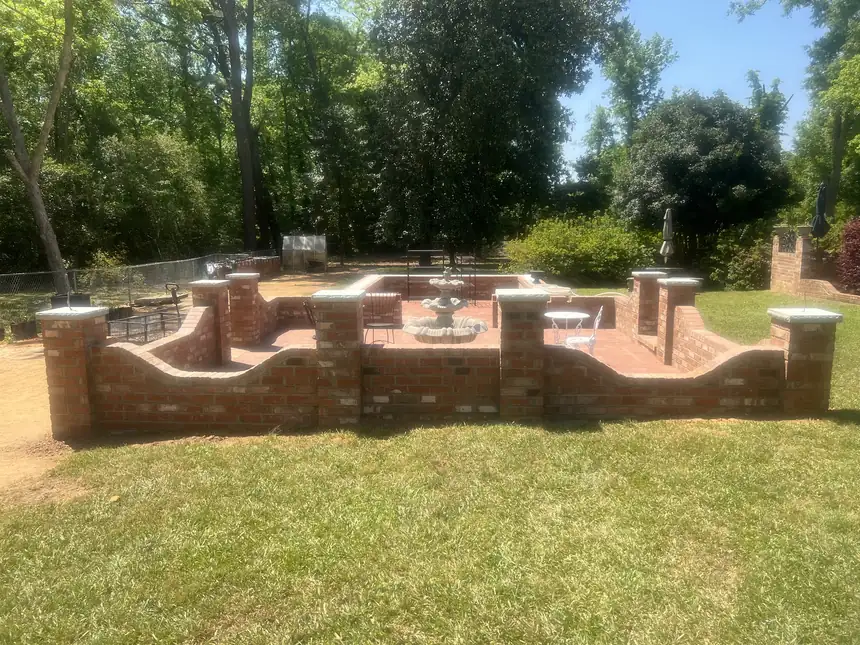
The profile matters too. Joints can be concave, flush, struck or raked, and each one catches light and sheds water differently. If your wall has a particular profile, the repair should follow it. A curved garden wall with capped piers, like the one in the photo here, depends on those joint lines to read cleanly.
Spalling and weather damage
If the faces of some bricks are flaking, peeling off in thin layers or crumbling, that's spalling. It usually comes from moisture trapped in the brick, often made worse by a mortar that was too hard or a wall that couldn't dry out. A few damaged bricks can be cut out and replaced with matching ones. Widespread spalling points back to the moisture source, and that's what needs to be solved.
Grinding out the old mortar to sound material, packing the joints in layers and tooling them to match is slow, careful work. It's not a job to rush. If your walls in Williston, Aiken or anywhere in the CSRA are showing any of these signs, call (803) 300-3734 or write to us through the contact page, and we'll take a look and tell you what's going on.
Bosse Stoneworks, LLC, (803) 300-3734
Call (803) 300-3734More articles
Signs Your Yard Needs a Retaining Wall
A yard rarely fails all at once; it tells you in small ways first, and a mason can read those signs.
What Shapes the Cost of a Retaining Wall
Two walls that look similar from the street can be very different jobs once you account for what's underneath.