Where facades fail: water behind the veneer
Most brick and stone trouble starts behind the face, not on it. Water gets past a hairline joint, runs down the back of the veneer, and has nowhere to go. Without flashing at the base of the wall and weep holes along the bottom course, that water sits against the structure until it freezes, stains the face, or rots what is behind it. A wet spring followed by a hot summer, which is ordinary weather around Williston and across the Aiken and Augusta side of the CSRA, works a bad detail hard.
So the first question on any facade is how water leaves the wall, long before anyone talks about the color of the brick. Weeps at the base, flashing over windows and doors, and an air space that stays open matter more than the face does. The other quiet culprit is mortar that is harder than the brick it holds. The brick then takes all the movement and spalls at its edges while the joints stay perfect, and the wall looks fine from the driveway for years before it doesn't.
How a course is laid: bed joints, head joints, tooling
Every course starts with a full bed of mortar, and each brick is shoved down into it so the joint fills instead of skimming the surface. The vertical head joints get buttered on the end of every unit, so there is no hollow behind the face for water to collect in. The line is pulled to the house's own lines, window heads, sills and corners, so new work does not drift out of level across forty feet of wall.
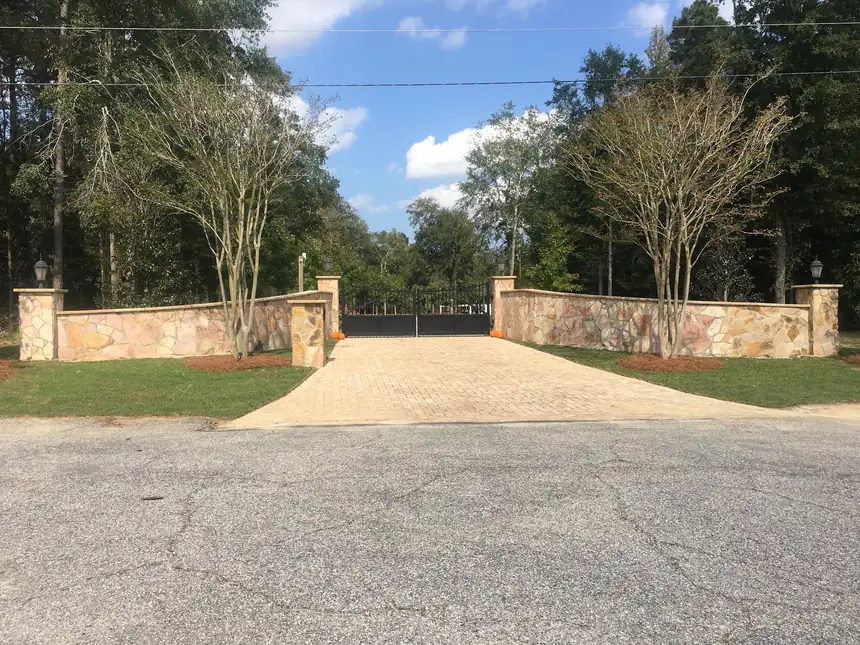
Joints are tooled once the mortar is thumbprint firm. Tooling compresses the mortar into the edges of the brick and sheds water, which a flush, raked-out joint will not do. Bosse Stoneworks describes this work as “precision brickwork and natural stonework designed to enhance your facade's structural integrity and curb appeal,” and on the wall it comes down to patient straight-edge work. Natural stone follows the same discipline with irregular units: each stone is set so the bed sits level, the face reads right, and the joint widths stay honest.
Matching what is already standing
Adding a stone-faced entry to a brick house, or extending an older facade, is where the eye catches a bad match. Brick varies from pallet to pallet and even within one, so a mason pulls from several to spread the color across the wall instead of leaving a patch. Mortar color and joint profile matter nearly as much as the brick. A concave joint and a struck joint look very different from the street, even in the same mortar.
Curb appeal is judged from the road, so that is where John and the crew step back and look before a wall is called done. The work covers residential, commercial and agricultural properties in Williston, Aiken, North Augusta, Augusta and Evans. If you have a facade in mind, or a wall that is staining and you want it read properly, call (803) 300-3734 and describe what you are seeing.