Why paving sinks, puddles and shifts
Pavers and flagstone do not fail on their own. They fail because of what is under them. A walkway that dips in the middle was laid on a base that was too thin or never compacted, and a patio that holds a puddle after rain was never given enough fall to drain. By the time you see a sunken corner or a rocking stone, the problem has been there since the day it was installed.
Bosse Stoneworks describes its paving as “interlocking paver installations, natural flagstone paths, and precision grading designed to eliminate standing water and prevent shifting over time.” In practice that means digging out soft ground, building a base of aggregate in compacted lifts instead of one loose pour, and setting the grade so water runs off the surface and away from the house. In Williston and across Aiken, Barnwell and Orangeburg counties, rain arrives hard and fast, so the pitch has to be right from the start.
Pavers or natural flagstone: what holds each one
Interlocking pavers hold because the units lock against each other. A screeded bed of bedding sand sets the height, the pavers are tapped down and compacted, and polymeric or plain joint sand is swept into the gaps so each unit braces its neighbors. The edge restraint is what keeps all of that from spreading outward over the years, which is why the border is set on the base before the field is laid and never left to chance.
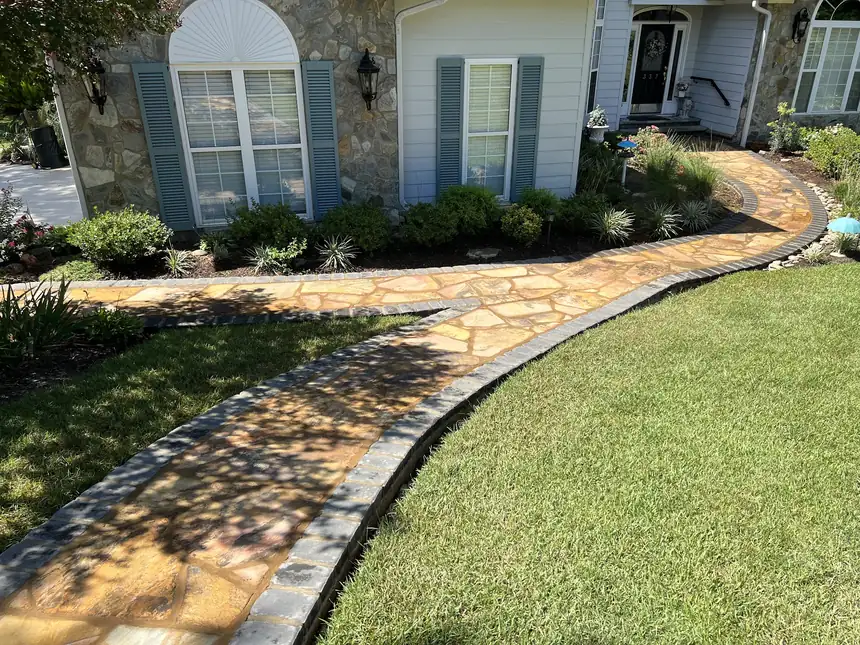
Natural flagstone is a different craft. Every piece is a different shape and thickness, so each one is fitted, shimmed to level on its bed, and tightened to its neighbors with joints that look natural without being wide enough to trip a heel. A flagstone path can curve, step, and wander through a lawn in ways a rectangular paver cannot, and a dark paver border can frame it so the curve reads cleanly against the grass.
Driveways carry trucks, so the build-up changes
A driveway is a patio that gets driven on. The base goes deeper than a walkway needs, the aggregate is compacted in thicker, well-controlled lifts, and the edging is stronger, because loaded wheels push outward at the edges. The spot where a driver turns the wheel while stopped, near the garage and at the curve, twists the pavers more than anywhere else, and those are the first places a thin base gives up.
Grading matters here too: a driveway should shed water away from the garage and not toward it. John and the crew lay paver and stone drives and walks for properties in Williston, Aiken, North Augusta, Augusta and Evans, and walk the ground first to see where water already wants to go. If you are weighing a walkway, a patio or a driveway, call (803) 300-3734 and tell them where the water sits today.