Find the root cause before anything gets mortar
Restoration at Bosse Stoneworks leans on one rule: diagnose first. A crack, a spalled brick face and a washed-out joint are symptoms, and the cause behind them is different from wall to wall. A downspout dumping against the base, water getting behind a veneer, a footing that has settled under one corner, a lintel rusting over a window: each calls for a different repair. Patch the surface without that and the damage comes back.
Walking a wall in Barnwell or Aiken, John and the crew read the pattern before they pick up a tool. Cracks that step up through the joints in a staircase line point toward movement in the footing. A single vertical hairline at a corner may only be the wall working with the seasons. Brick faces flaking off in sheets usually mean moisture trapped behind them, cycling wet and dry, and the fix is to let that water out and keep it out.
Tuckpointing and custom mortar matching, with softer mortar than the brick
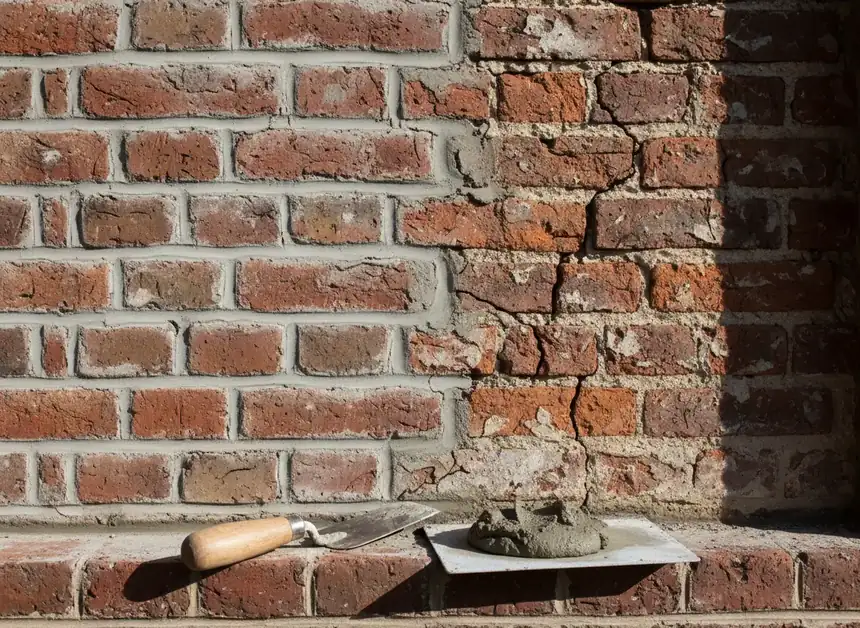
Their repair work lists historic tuckpointing, deep crack sealing, and custom mortar matching. Tuckpointing means raking the failed joint out deep enough to reach sound mortar, brushing it clean, and repacking it in layers so the new mortar bonds all the way through instead of skinning over a hollow. A joint filled flush on the surface only looks repaired for a season or two.
The mortar itself matters as much as the labor. Old brick, especially the soft kiln-fired kind found on older Aiken and Augusta buildings, needs a mortar that is softer than the brick, with enough lime content to let the wall give a little. A hard modern mix on soft brick pushes the movement into the brick faces and spalls them. Color and joint profile get matched to the wall as it stands today, which their repair page calls “Seamless Material Matching,” so the repair reads as part of the wall.
Structural cracks, lintels and spalling: when repair beats rebuild
The same page names structural crack repairs, foundation stabilization, and lintel replacement. Lintels are the steel or stone members over a window or door, and a steel one that rusts swells and jacks the brick above it, which is why step cracks climb away from the corners of an opening. Replacing one means supporting the wall above, cutting the old member out, setting a new one with proper flashing, and rebuilding the courses over it.
Spalling and weather damage get the same honest sorting: brick faces that have lost their skin can be cut out and replaced one at a time, while a wall that has bowed or is pulling off the house is a rebuild conversation, not a patch. If you have a wall in Williston or North Augusta that you suspect falls into one of those camps, call (803) 300-3734 on a weekday between 7 and 4 and describe what you are seeing.