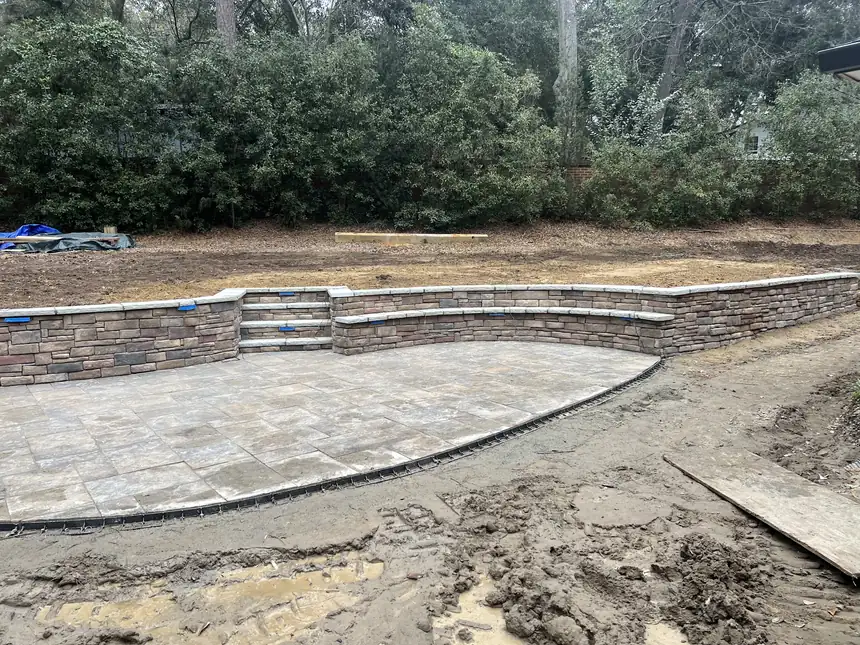
Why a slope pushes, and what the wall has to be built to hold
A retaining wall is holding back a slow, heavy push. Wet soil weighs far more than dry soil, and a slope that has been soaked through a Carolina storm leans on the wall in a way a dry afternoon never reveals. The warning signs are usually on the ground first: soil washing out of beds, a yard that slopes toward the house, erosion lines after rain, water standing where it should drain.
Bosse Stoneworks describes its walls as “heavy-duty stone block engineering and integrated drainage systems designed to handle intense soil pressure safely.” That is the right pairing. A wall that is only heavy will still fail if water builds up behind it, and a wall with good drainage but a poor base will tip from the bottom. Both halves have to be built in, from the first course to the last.
Gravel, drain pipe and setback: the part behind the face
Start at the bottom. The trench is cut to a firm, level bed and the base course is compacted and checked, because every course above inherits whatever error it carries. Block is stepped back slightly with each course, a setback called batter, so the wall leans into the hill and not away from it. On taller walls, builders commonly lay geogrid back into the slope between courses to tie the face to a larger mass of soil.
Behind the face goes clean gravel backfill, not the dirt that came out of the hole, with a perforated drain pipe running along the bottom that carries water out to the side or to daylight. Water that cannot pass through the wall has to be given a path around it. This is the piece nobody sees once the wall is finished, and it is the piece that decides whether the wall is still straight after ten wet winters.
What changes the cost of a retaining wall
John Bosse has written a guide to retaining-wall costs in South Carolina, and the factors in it are the same ones that shape every wall. Height and length come first, because pressure rises quickly as a wall gets taller. Material follows: block and natural stone are different jobs with different labor. Soil conditions and the layout of the yard, including curves, corners and steps, change how much has to be dug and how it has to be built.
Accessibility matters because machines and block have to reach the site, and drainage and prep, the digging, grading and base work before the first course, are often a larger share of the work than homeowners expect. That is why a wall is priced after someone has walked the slope. If you have a hill in Williston, Aiken, North Augusta, Augusta or Evans that is washing out, call (803) 300-3734 and describe it.