Signs Your Yard Needs a Retaining Wall
A yard rarely fails all at once; it tells you in small ways first, and a mason can read those signs.
October 15, 2026 · 4 min read
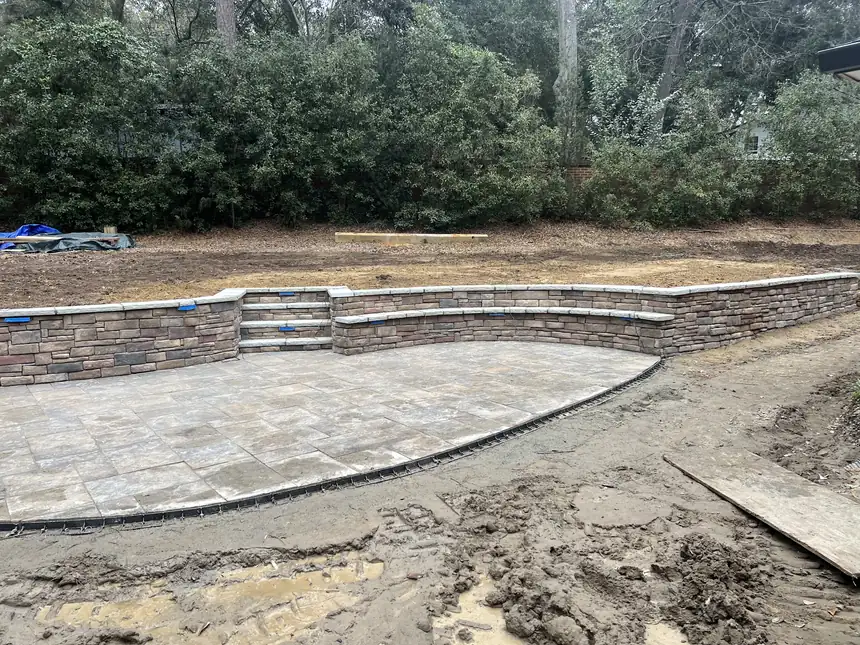
Most people don't wake up one morning and decide they need a retaining wall. They notice the mulch keeps ending up in the driveway. They notice a muddy fan of soil across the walkway after every hard rain. They notice the slope behind the house has gotten steeper, or at least harder to mow. Those are the early signs, and they're worth reading, because a slope that's already moving only moves faster as time goes on.
At Bosse Stoneworks we've spent 48 years around soil, stone and brick, and the pattern is familiar. Below are the signs we'd look for if you called us out to a property in Williston, Evans or anywhere else in the CSRA, and how we'd think about whether a wall is the answer.
Soil that keeps moving
A stable slope holds its shape. If yours doesn't, you'll see it at the bottom first. Soil piles up against a foundation, a fence, a patio edge or the back of a sidewalk. Grass at the base of the slope gets buried, while the top of the slope looks thin and scalped. That's soil on the move, carried a little at a time every time it rains.
Look at the things that were built straight and are no longer straight. A fence line that leans downhill, a mailbox post that has tilted, steps that have pulled away from a stoop, or a patio slab with a gap opening on the uphill side all point to ground that's shifting underneath them. Anything that was level when it was installed makes a good measuring stick.
A quick checklist for your own yard
You don't need any tools for a first look. Walk the property after a good rain and keep an eye out for the following.
- Soil or mulch washed onto a walkway, driveway or patio after storms
- Bare channels or small gullies running down a slope where grass won't hold
- Plant roots exposed along a bed edge, as though the ground dropped away from them
- Puddles that sit at the foot of a slope for a day or more after the rain stops
- A slope too steep to mow safely, so it's gone to weeds or just gets skipped
- Cracks in a patio, a driveway edge or a foundation-adjacent walk that run along the slope
- Fence posts, light posts or railings leaning in the downhill direction
One item on that list might be a nuisance. Three or four together usually mean the slope has a job to do that the grass and the plants alone can't handle.
Water is usually the real culprit
When people ask what's wrong with their slope, the honest answer is often water. Soil holds up well when it stays at a steady moisture level. Once rain or roof runoff pours across it, or soaks in behind it and has nowhere to go, the soil loosens and gets heavy. A downspout aimed at the top of a bank, a low corner where the yard funnels runoff, or a neighbor's grade that sends water your way can all do the damage.
That's why a wall is never just a stack of stone. A well-built retaining wall deals with the water as well as the soil: a drainage layer behind the wall, a way for that water to leave, and a base that won't wash out underneath. A wall that holds back dirt but traps water behind it will push, bulge or lean sooner or later. We design the drainage first and let the wall follow from it.
When a wall is the fix and when grading is enough
Not every sloping yard needs a wall, and we'd rather tell you that than build something you don't need. If the slope is gentle, the grass is healthy and the only complaint is a soggy corner, reshaping the grade and redirecting a downspout might solve it. Grading moves soil around. It works when the land can be laid back at an angle that stays put on its own.
A wall earns its place when there isn't room to lay the slope back. Maybe the hillside runs right up to the house, a driveway or a property line. Maybe the grade change is simply too abrupt for soil to hold at that angle, and every time you regrade it slumps again. In those cases you're not fixing a drainage problem so much as holding up a piece of ground, and that's a structural job.
A wall can also give you something back. Stepping a steep bank into level terraces turns unusable ground into a flat bed, a seating area or a spot for a paver patio. Some of the most useful yards we see started as a hillside that nobody could do anything with.
What a sound wall looks like
If you do decide on a wall, the parts you can't see matter most. A solid, level base. Stone or block that's stacked and set so each course locks into the one below. Backfill that drains instead of holding water. A sturdy cap on top. The face is what you'll admire, and we're glad to match it to the brick or stone on your house, but the wall stands or falls on what's behind it.
If any of the signs above sound like your yard, give us a call at (803) 300-3734, or send a note through the contact page. We'll look at how the water moves across your property and tell you plainly whether you need a wall, some grading or nothing at all.
Bosse Stoneworks, LLC, (803) 300-3734
Call (803) 300-3734More articles
What Shapes the Cost of a Retaining Wall
Two walls that look similar from the street can be very different jobs once you account for what's underneath.
Masonry Outdoor Kitchen or Prefab Kit
A kit is quick to buy, but a kitchen built in brick or stone is shaped around your yard and your cooking.