Why outdoor fireplaces smoke, and what fixes it before the first stone
A fireplace that smokes is almost always a proportion problem, not a mystery. The opening is too large for the flue, the throat is too narrow, there is no smoke shelf behind the damper, or the stack is too short to pull. Wind curling around a freestanding structure makes every one of those worse than it would be on the side of a house, so an outdoor firebox has less room for error than an indoor one.
Getting it to draw is geometry settled before any stone is laid: opening width and height measured against the flue, a sloped back wall that leans the fire forward, a smoke shelf that catches downdraft and turns it back up the stack, and a chimney tall enough to clear what is around it. Bosse Stoneworks describes its fireplace work as “thermal firebrick engineering and custom stone masonry designed to maximize heat output and direct smoke safely away.” That is the right order of operations: the firebox first, the stone second.
Thermal firebrick inside, the stone you chose outside
The firebox is lined with firebrick laid in thin joints of refractory mortar, because ordinary brick and ordinary mortar crack under repeated hard heat. Firebrick is dense, it holds heat well, and the angled walls throw it back out toward the people sitting in front of it. A small gap between the liner and the outer masonry lets the two expand at different rates without telling on themselves as a crack in the face.
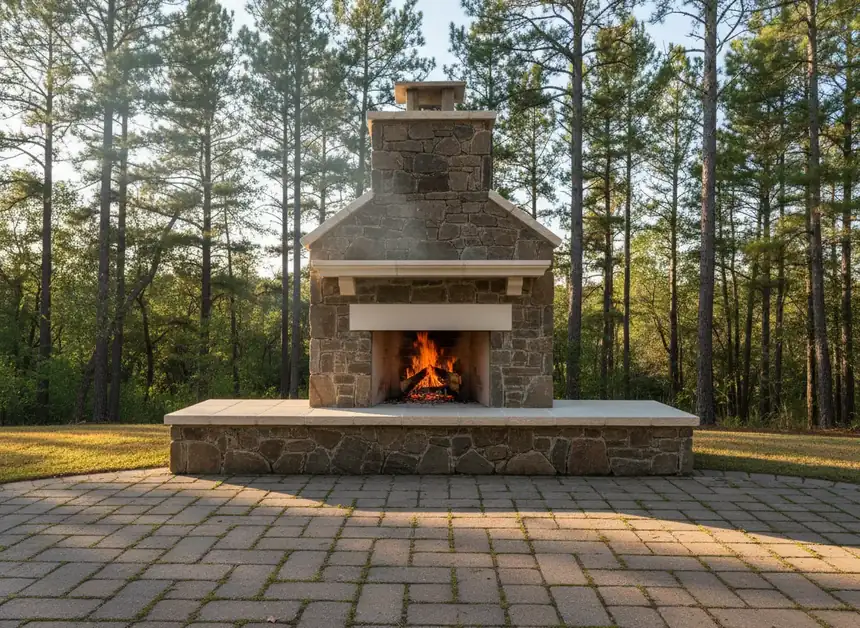
Outside the liner, the choice opens up. Fieldstone, cut stone, or brick to match the house or the patio wall all work, with a lintel over the opening and the face carrying on up the stack. A stone or cast stone mantel gets set into the courses as the wall rises rather than stuck on afterward, which is why it looks like it belongs to the structure instead of resting against it.
The footing and hearth that carry the weight
A masonry fireplace puts a lot of weight on a small piece of ground. Stone, block and firebrick together can run to several tons, so the footing beneath it has to go below the soft top layer, extend past the footprint, and be reinforced so one side never settles and opens a crack up the stack. This is the part nobody photographs, and it decides whether the fireplace is still plumb in twenty years.
The hearth runs out in front of the opening as a stone or paver apron where stray embers land, and it ties into the patio so there is no step or gap at the fire. Many homeowners pair a fireplace with a paver patio and an outdoor kitchen to make a complete outdoor living space. John and the crew build these for yards in Williston, Aiken, North Augusta, Augusta and Evans, and the first conversation is usually about where the seating will sit and which way the wind comes from.