Masonry Outdoor Kitchen or Prefab Kit
A kit is quick to buy, but a kitchen built in brick or stone is shaped around your yard and your cooking.
October 15, 2026 · 4 min read
Walk through any home center and you'll find outdoor kitchen kits stacked on pallets: steel frames, stucco panels, facing you can attach in a weekend. They look convenient, and for some people they're a fine answer. But if you're planning a kitchen you want to still be using years from now, it's worth understanding what a masonry kitchen does differently.
Our approach at Bosse Stoneworks is simple. Unlike prefabricated kits, a masonry kitchen is built on a solid foundation and designed to last for decades. That one sentence carries most of the argument, so let's unpack it.
It starts with the foundation
A grill island is heavy. Add stone or brick facing, a countertop, a built-in grill, a sink and storage, and you have a lot of weight in one place, sitting outside through summer storms and winter cold. A kit often rests on whatever surface is under it. A masonry kitchen gets its own prepared base: excavated, compacted and built up so the structure stays level and doesn't settle or crack.
Foundation work is also where the cost of a poor kitchen shows up later. When a base shifts, doors stop closing, countertops crack and joints open. Nobody enjoys a grill island that tilts a little further each year. We put the effort into the part you can't see so the part you can see stays put.
Layout built around how you cook
A kit comes in set sizes. A masonry kitchen comes in your size. Before we pour or lay anything, we talk through how you really cook and entertain, because the layout decides whether the kitchen is a pleasure or a nuisance.
Space can be planned for grills, smokers, sinks, storage and countertops, arranged the way your household works. Some people want a long counter so guests can sit across from the cook. Others want a smoker set at the end of the run, away from where people gather. A sink near the grill saves a lot of trips to the back door. Drawers and cabinet doors should sit where a cook's hands actually go.
- Where the grill sits relative to wind and to where guests will stand
- How much counter space you want on each side of the heat
- Where a smoker fits so smoke drifts away from seating
- Storage for tools, tanks and supplies that stays dry and reachable
- A sink placement that works for both prep and cleanup
- Any gas, water or electric connections, planned before the base is built
That last item is worth noting. Utility connections are best thought through before the structure goes up, so that lines run where they should and nothing has to be cut into finished masonry later.
Matching the house
One of the real advantages of building in brick or stone is that the kitchen can look like it belongs to the house. If your home is brick, we can match the brick. If you have a stone front, we can carry that stone into the outdoor kitchen. Matching the color, the texture and the mortar joint is a skill in itself, and it's the difference between a kitchen that looks added on and one that looks like it was always there.
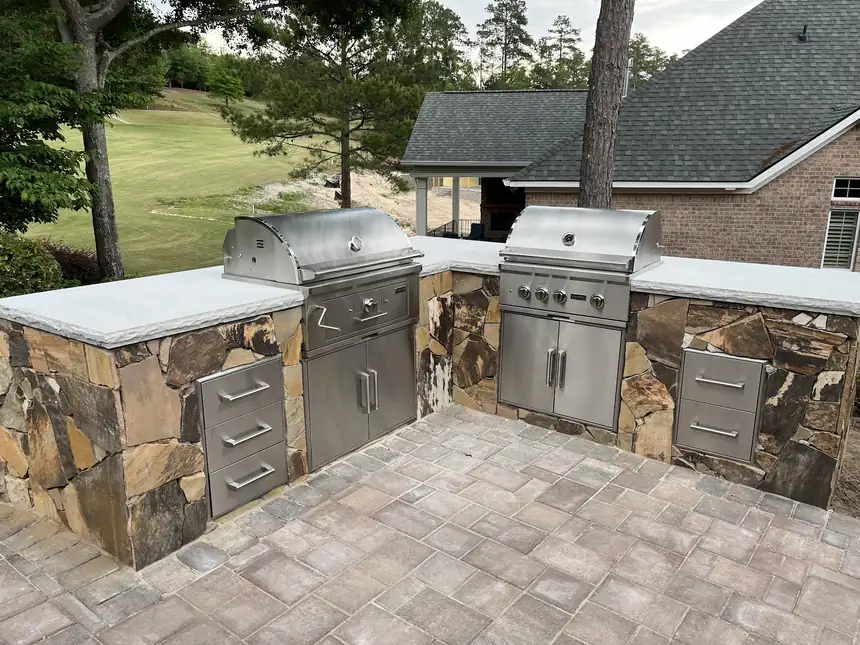
The photo with this article shows a flagstone-clad kitchen base with two stainless grills and drawers set into a paver patio. It's one of the projects from our own work, and it shows how stone, steel and pavers can sit together without competing.
Pairing it with a patio and a fireplace
Many homeowners combine an outdoor kitchen with a paver patio and an outdoor fireplace to create a complete outdoor living space. It makes sense. The kitchen is where the cooking happens, the patio gives people somewhere to sit and eat, and the fireplace pulls everyone together once the sun goes down. Planned together, the three share materials, levels and traffic paths, so the whole space feels intentional.
Planning them together also saves trouble. If the patio is laid first and the kitchen added later, you can end up cutting into finished pavers or fighting a grade that doesn't suit the kitchen. We'd rather map the whole space on day one, even if you build it in stages.
When a kit makes sense
In fairness, a kit has its place. If you want a simple setup, you're not sure how long you'll stay in the house, or the budget points elsewhere, a prefabricated unit can get you cooking outdoors. Our argument is for the homeowner who wants a kitchen that is built once, built to the property, and still in good shape long after a kit would have been replaced.
If you're weighing it up in Evans, North Augusta or anywhere nearby, we're glad to talk it through, even if you're still deciding. Call (803) 300-3734, or leave us a note on the contact page with a rough idea of what you'd like to cook on, and we'll go from there.
Bosse Stoneworks, LLC, (803) 300-3734
Call (803) 300-3734More articles
Signs Your Yard Needs a Retaining Wall
A yard rarely fails all at once; it tells you in small ways first, and a mason can read those signs.
What Shapes the Cost of a Retaining Wall
Two walls that look similar from the street can be very different jobs once you account for what's underneath.