Pavers or Flagstone for a Walkway
Both make a good walk, but they behave differently over the years, and the base underneath matters more than the surface.
October 15, 2026 · 4 min read
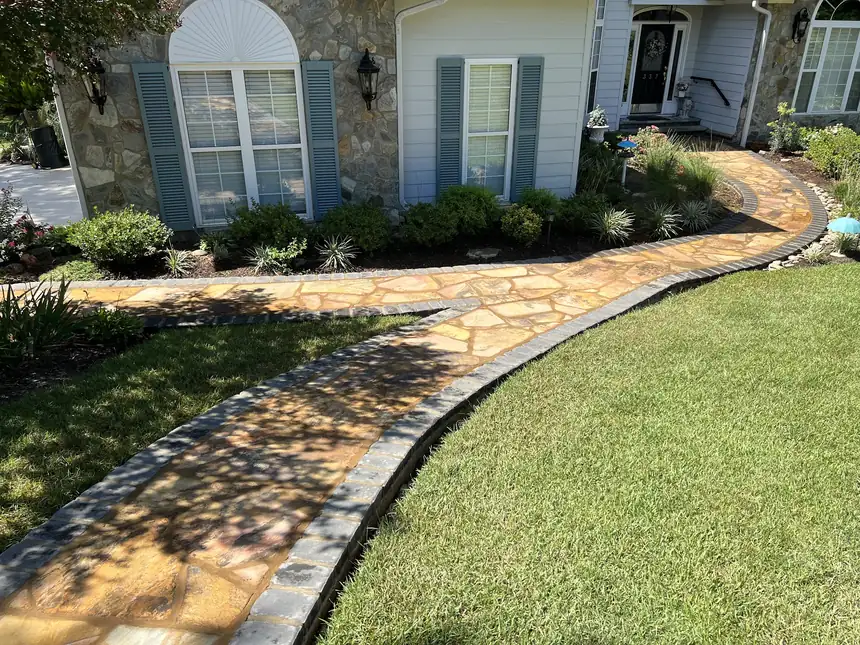
A walkway is one of those projects that people notice every single day. It's the first thing a guest walks on and the thing you cross with groceries in the rain. When homeowners ask us whether to choose interlocking pavers or natural flagstone, the honest answer is that both work well. Which one is better depends on where the walk goes and what you want it to feel like.
Here's how we think it through with a customer, whether the house is in Williston, Aiken or over in Evans.
The base is the real work
Before comparing the surfaces, it helps to know that the surface is the smallest part of the job. What decides whether a walkway stays smooth for years is what's under it. That means excavating the soft top layer, building up a compacted base of crushed material, and shaping the grade so water runs off instead of pooling. Our walkway work centers on interlocking paver installations, natural flagstone paths, and precision grading designed to eliminate standing water and prevent shifting over time.
Standing water is the enemy of any hard surface. It softens the base, lets pieces settle unevenly and creates slick spots. A walk with the right slope, a good base and a way for water to leave will outlast one that looks identical but skipped those steps. Always ask what's under a quote before you ask what's on top.
Interlocking pavers
Pavers are manufactured units, uniform in size and thickness, laid in a pattern over a bed of sand and locked together by their edges and by the joint fill between them. Because they're uniform, they go down in clean lines, and they work well for formal, straight walks that lead up to a front door. The range of colors and patterns is wide, so it's easy to pick something that suits the brick or siding on the house.
Pavers also handle repair gracefully. If a section settles or a utility line needs access, individual units can be lifted and reset without tearing up the whole walk. Over time the joint fill may need topping up, and the color can soften with sun and weather, but the surface stays flat and predictable.
Natural flagstone
Flagstone is quarried stone, split into flat pieces that are each a little different in shape, color and thickness. A flagstone walk has a relaxed, organic character. No two stones match, so the walk looks like it grew out of the landscape, which is why it suits garden paths and cottage-style entries so well. The curved flagstone walkway in the photo, with dark paver edging running through the lawn, is a good example.
It does ask more of the installer. Each piece has to be fitted to its neighbors, with the gaps kept consistent and the top surface kept even enough to walk on comfortably. The joints can be filled with stone dust, with a binder, or with ground cover, depending on the look and the use. Over the years flagstone develops a patina, and in shady, damp spots it can grow moss and get slippery, so it's worth thinking about where the walk sits.
Edging holds it all together
Whichever you choose, the edge is what keeps the walk from spreading. Pavers rely on a firm edge restraint to stay locked together, and without one they gradually drift apart. A flagstone path benefits from a defined edge too, whether that's a row of pavers, a stone border or a steel or concrete restraint. A good edge also gives the walk a clean line where it meets the lawn or bed, and it makes mowing easier.
Which fits where
- Front walk: pavers give a clean, formal approach; flagstone gives a more relaxed one, and either can look right if it matches the house
- Garden path: flagstone is a natural fit, especially with a curve and plantings along the edge
- Driveway: interlocking pavers are the practical choice, since the base and units can be built for vehicle loads
- Patio connection: pavers make the transition easy when the walk leads into a paver patio
- Steps and slopes: both can work, but the layout and base need careful planning on any grade
Many of our customers mix the two, using pavers for the main approach and flagstone for a side path or a patio inset. There's no rule against it, and the combination often looks better than either material alone.
If you're planning a new walk, a replacement for one that's cracked and heaved, or a driveway upgrade anywhere in the CSRA, we'd be glad to look at it with you. Call (803) 300-3734 or send a note through the contact page, and we'll talk about the grade, the materials and what suits your property.
Bosse Stoneworks, LLC, (803) 300-3734
Call (803) 300-3734More articles
Signs Your Yard Needs a Retaining Wall
A yard rarely fails all at once; it tells you in small ways first, and a mason can read those signs.
What Shapes the Cost of a Retaining Wall
Two walls that look similar from the street can be very different jobs once you account for what's underneath.